
Decoding Tech Specs & Production: A Custom Bedding Manufacturer Guide
How to Interpret Technical Specifications and Production Processes When Selecting a Custom Bedding Manufacturer
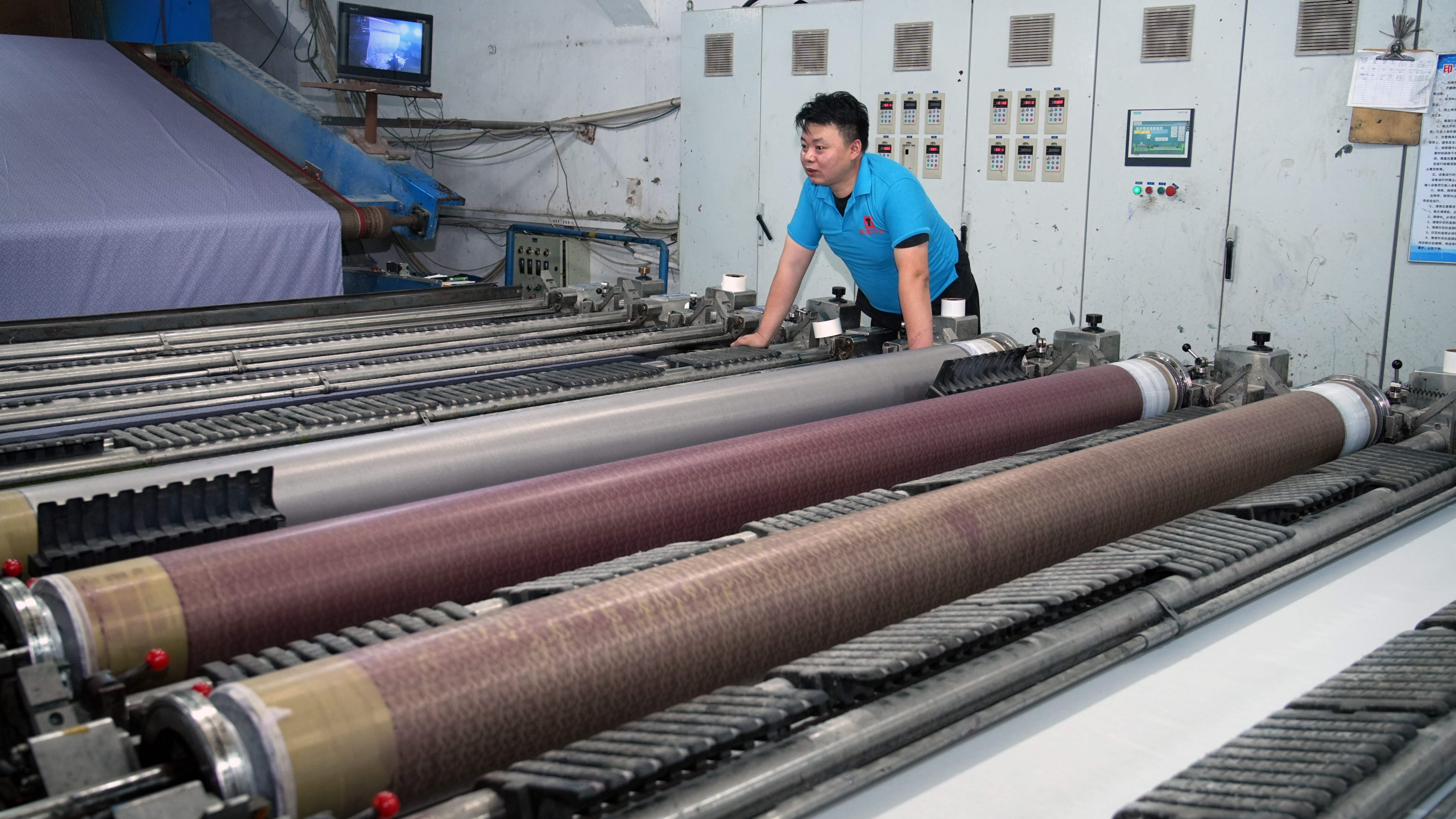
A modern textile workshop where precision equipment and skilled labor transform raw fabric into finished bedding products.
When sourcing custom bedding from a Bedding Manufacturer China, you are not just buying a finished product. You are buying a complex combination of raw materials, engineering standards, and manufacturing craftsmanship. The difference between a supplier that delivers consistent, high-quality hotel sheeting and one that causes repeated complaints often lies in two areas: technical specifications and production processes.
For procurement professionals, brand owners, and hospitality buyers, understanding how to read a spec sheet and evaluate a factory's production line is the single most important skill to avoid costly mistakes. This guide from CODE TEXTILES, a Hong Kong-based Home Textile Manufacturer with a strong presence in Europe and Asia, breaks down exactly how to decode these elements to make an informed choice.
The Problem: Why Most Buyers Misread Technical Specifications
Many buyers assume that a higher thread count always means better quality. This is a common misconception. A 1000-thread-count sheet made from short-staple fibers can pill and feel rough, while a 300-thread-count sheet made from long-staple Egyptian cotton can be buttery soft and last for years. The truth is that quality is not a single number; it is a system of interlocking parameters.
Similarly, production processes like digital printing bedding versus pigment printing fabric produce drastically different aesthetics and durability. Without understanding these nuances, buyers risk ordering bedding that fades after three washes, shrinks out of fit, or fails flammability tests.
Industry Background: The Modern Custom Bedding Supply Chain
The global home textile manufacturer landscape has evolved. China remains the world's largest producer of bedding, but the range of capabilities varies widely. Leading factories now offer OEM Bedding Supplier services with advanced technologies like digital textile printing, automation in cutting and sewing, and environmentally certified production lines.
Companies like CODE TEXTILES leverage Hong Kong's trade infrastructure and Mainland China's manufacturing clusters (e.g., Jiangsu, Zhejiang) to deliver both Private Label Bedding Manufacturer and large-scale hospitality contracts. They also hold internationally recognized certifications such as GRS Certified Textile Manufacturer (Global Recycled Standard) and CE marks, which are critical for European buyers.
Detailed Solution: How to Interpret Key Technical Parameters
Below is a structured breakdown of the most important technical specifications you will encounter when sourcing custom bedding. Each parameter directly affects the final product's performance, feel, and compliance.
1. Yarn Count (Ne) & Thread Count (TC)
| Parameter | What It Means | Impact on Quality | Typical Range for Bedding |
|---|---|---|---|
| Yarn Count (Ne) | Thickness of a single yarn (higher = finer) | Finer yarns produce softer, lighter fabric but require higher quality fiber | 40s – 80s for sheets; 60s – 100s for premium |
| Thread Count (TC) | Number of warp and weft threads per square inch | Higher TC can indicate denser fabric, but can be inflated with multi-ply yarns (misleading) | 200 – 400 for durable hotel sheets; >400 for luxury |
Key insight: Always ask for the single-ply yarn count. Many suppliers use two-ply yarns to artificially boost thread count. A true 300 TC single-ply 60s cotton is superior to a 600 TC two-ply 40s cotton.
2. Fabric Construction: Weave Type
- Percale: Plain weave, crisp, breathable, matte finish. Ideal for hot sleepers.
- Sateen: Satin weave, smooth, lustrous, slightly heavier. Preferred for luxury hotels.
- Twill: Diagonal weave, durable, wrinkle-resistant. Common for duvet covers.
3. Fabric Weight (GSM)
Grams per square meter (GSM) is critical for towels, blankets, and mattress protectors. For bed sheets, GSM is less common but can indicate thickness. A Custom Bedding Manufacturer should provide both weight and thread count to avoid confusion.
4. Colorfastness & Shrinkage
- Colorfastness to washing: Rated 1–5 (5 is best). Minimum 4 for hospitality use.
- Colorfastness to light: Important for hotels with large windows. Minimum 4.
- Shrinkage: Usually expressed as a percentage (e.g., ≤3% in warp/weft). Lower is better.
5. Finishing & Chemical Compliance
European buyers must check for OEKO-TEX Standard 100, REACH compliance, and formaldehyde limits. A GRS Certified Textile Manufacturer can provide recycled content certificates. CODE TEXTILES holds GRS certificate number IDF-24-712326 and CE certificate SH015148125, ensuring eco-friendly and safe products.
Production Processes: How Manufacturing Affects Quality
The best spec sheet means nothing if the factory cannot execute consistently. Here are the critical production stages and what to look for.
Step 1: Yarn Preparation & Fabric Knitting/Weaving
Quality begins with the fiber. Long-staple cotton (e.g., Egyptian, Supima) or GRS-certified recycled polyester ensures strength. For Custom Printed Fabric, the base fabric must be properly singed and desized to ensure uniform dye uptake.
Step 2: Digital Printing vs. Pigment Printing
| Printing Method | How It Works | Best For | Durability |
|---|---|---|---|
| Digital Printing Bedding | Inkjet directly on fabric – no screens needed | Small batches, complex designs, photo-realistic patterns | High (with proper fixation) – vibrant, soft hand feel |
| Pigment Printing Fabric | Pigment applied with binder – requires heat setting | Large runs, cost-effective, eco-friendly (less water) | Good for cotton – may have slightly stiffer hand |
At CODE TEXTILES, we use advanced digital printing technology to produce Digital printing samples with high color accuracy and softness, ideal for custom branded bedding.
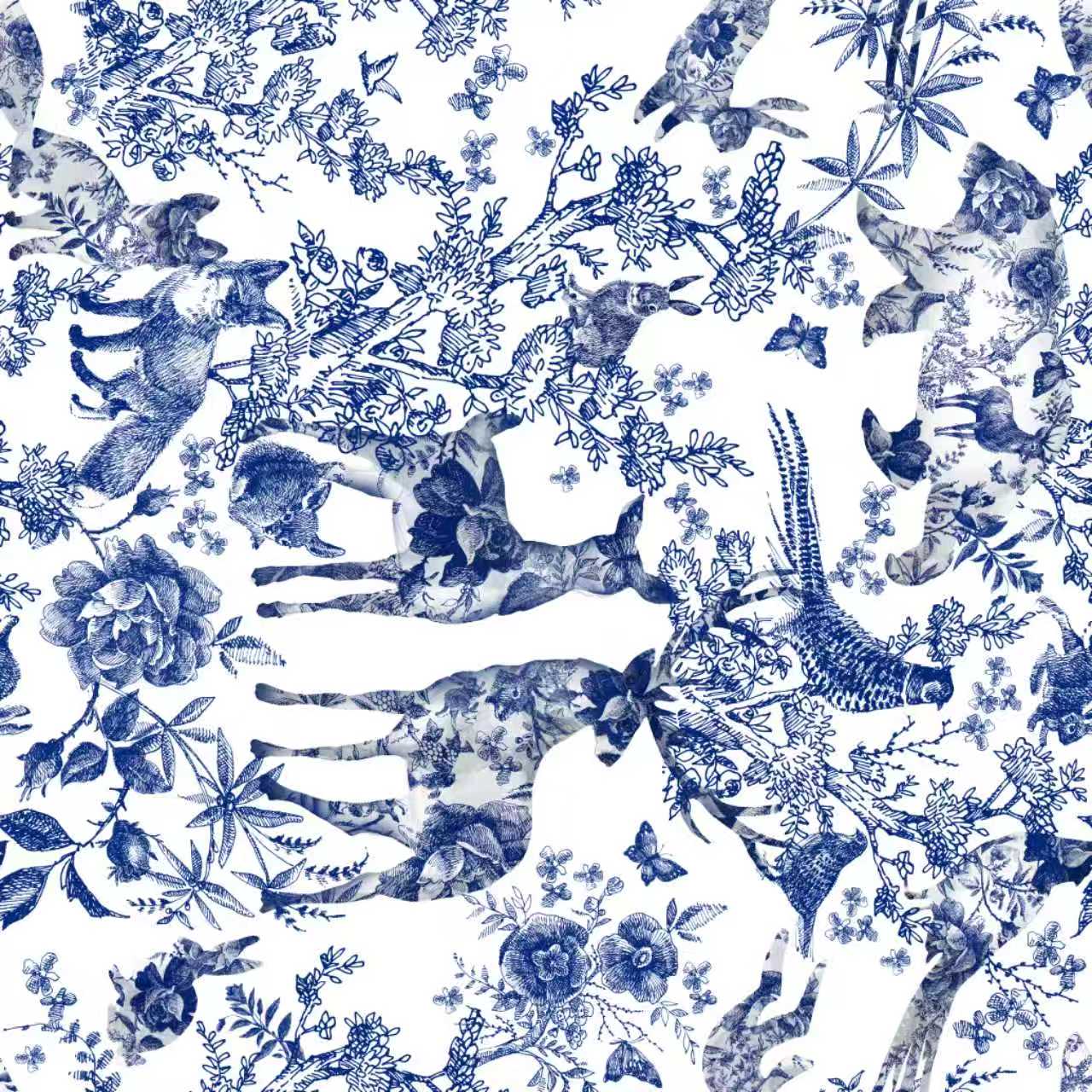
Digital printing enables intricate designs with minimal environmental impact – a key differentiator for modern custom bedding.
Step 3: Pre-treatment & After-treatment
- Scouring & Bleaching: Removes natural oils and whiten the fabric.
- Mercerization (for cotton): Increases luster and strength.
- Sanforization: Mechanical shrinkage control – essential for bedding that stays fitted after washing.
- Softening & Anti-pilling finishing: Adds softness and prevents fuzz.
Step 4: Cutting & Sewing
Automated cutting machines reduce waste and improve consistency. For OEM/ODM production, ask about seam types (e.g., French seams for luxury), thread quality (polyester core-spun), and stitch density (8–10 stitches per inch is standard).
Step 5: Quality Control & Certification
A reliable Custom Bedding Manufacturer should have in-house labs testing for tensile strength, seam slippage, colorfastness, and dimensional stability. Check for third-party certifications: GRS, OEKO-TEX, CE, and ISO 9001. CODE TEXTILES provides a Scope Certificate for GRS (BVC-TE-99951737-GRS-2512-50006713-V1.0) and CE certification, ensuring full traceability from recycled fiber to finished product.
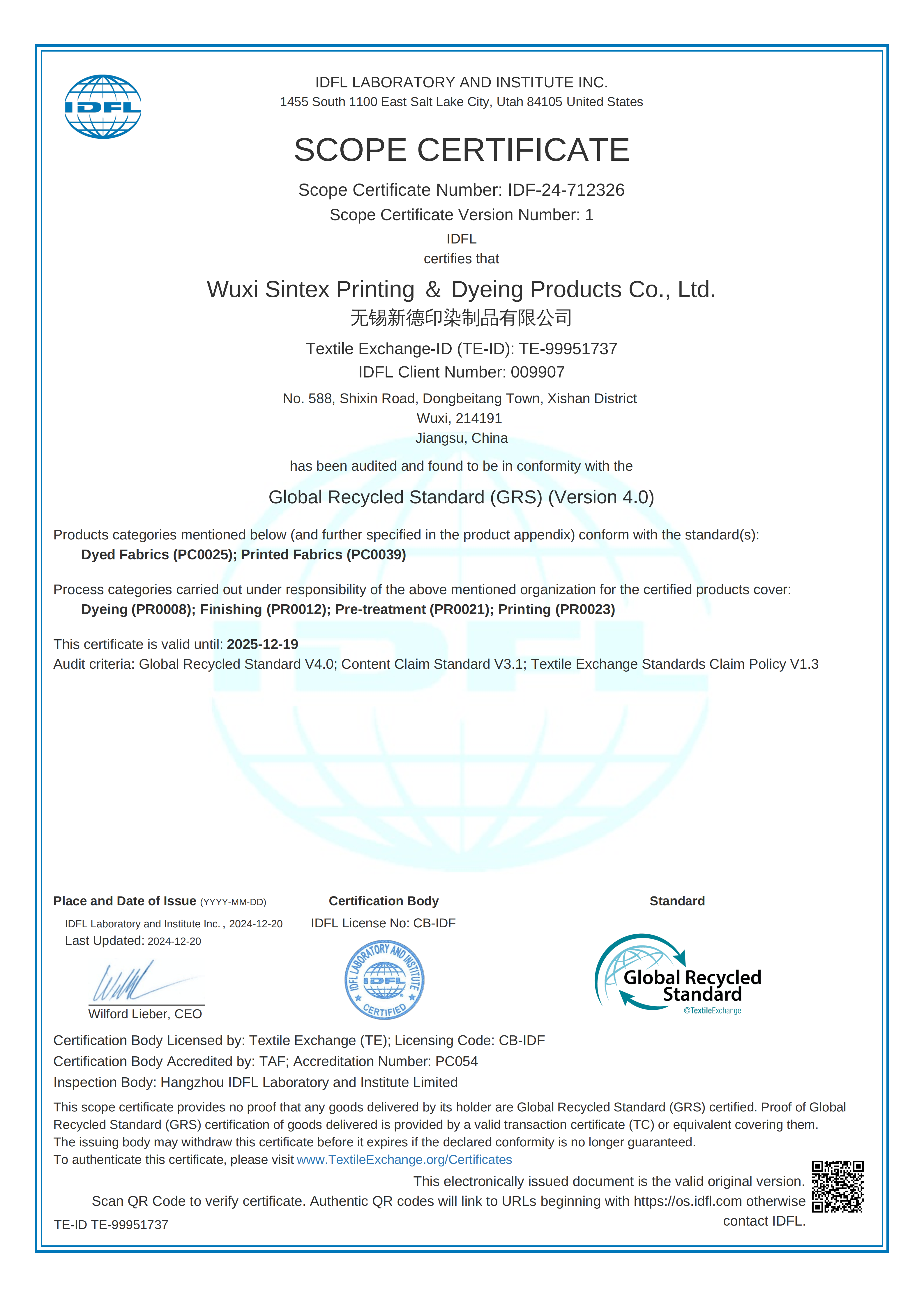
GRS certification guarantees that your custom bedding meets global recycled content standards – a vital requirement for sustainable procurement.
Use Cases: Applying This Knowledge
Case 1: Hospitality Hotel Chain Ordering 5000 Sets of Sheets
Requirement: 300 TC percale, 50% recycled polyester, digital print with hotel logo, OEKO-TEX certified.
How to evaluate: Ask the OEM Bedding Supplier for a spec sheet showing yarn count (Ne 60/1), construction (1/1 plain weave), shrinkage test results (≤2%), and proof of GRS-certified yarn. Visit the factory's digital printing line to verify color matching. CODE TEXTILES has experience with European hotel groups and can provide small batch digital print samples for approval before mass production.
Case 2: Retail Brand Launching a Private Label Organic Cotton Duvet Cover
Requirement: 100% organic cotton, sateen weave, pigment print, custom packaging.
How to evaluate: Check if the 100% Cotton Bedding Manufacturer has GOTS certification for organic cotton. For pigment printing, ensure the fabric undergoes proper heat setting to prevent color rubbing. Ask for a wash test report after 5 cycles.
Frequently Asked Questions
What is the most important technical specification for bedding?
For cotton bedding, yarn count (Ne) and thread count (TC) are the most commonly cited, but fabric construction (weave) and finishing (sanforization) have a greater impact on durability and feel. Always request actual test data rather than relying on marketing numbers.
How does digital printing compare to pigment printing in terms of durability?
Digital printing (with reactive dyes for cotton or disperse dyes for polyester) generally offers better colorfastness to washing and light compared to pigment printing. However, modern pigment printing with advanced binders has improved significantly. For designs requiring high resolution and soft hand, digital printing is preferred.
Why should I choose a GRS certified textile manufacturer?
GRS certification ensures that recycled content is traceable through the entire supply chain – from fiber to finished product. This is increasingly mandatory for EU retailers and brands with sustainability targets. CODE TEXTILES holds GRS certificate IDF-24-712326 and can provide transaction certificates for each shipment.
What should I look for when visiting a bedding factory?
Focus on three areas: (1) Raw material storage – clean and labeled bales; (2) Printing/weaving area – modern machinery and dust control; (3) QC lab – testing equipment for tensile strength, color spectrophotometer, and wash tests. A good Textile Printing Factory will have separate areas for pre-treatment, printing, and finishing to avoid contamination.
Can a custom bedding manufacturer handle small Minimum Order Quantities (MOQs)?
Yes, especially if they offer digital printing. CODE TEXTILES supports flexible small-batch production for custom printed fabric and private label bedding, allowing you to test the market before committing to large volumes.
Conclusion: Making an Informed Procurement Decision
Interpreting technical specifications and understanding production processes is not just a technical exercise – it is a strategic skill that reduces risk and ensures product-market fit. By focusing on the parameters that truly matter (yarn count, weave, finishing, and certifications) and evaluating the factory's capabilities (digital printing, automated cutting, QC protocols), you can confidently partner with a Custom Bedding Manufacturer that meets your quality, sustainability, and cost requirements.
For over a decade, CODE TEXTILES (HONG KONG) GROUP CO., LIMITED has been helping international brands, hotel groups, and retailers navigate these complexities. With a strong supply chain in China, certifications including GRS and CE, and expertise in digital printing bedding and pigment printing fabric, we offer a one-stop solution for custom bedding.
Ready to discuss your next project? Contact us today to request spec sheets, certification documents, or digital printing samples.
Contact person: Cocoa Ye
Email: CodeHK@hotmail.com
Telephone/WhatsApp: +852 66729268
Website: www.codetextiles.com
Address: RM 2804B 28/F WU CHUNG HOUSE, 213 QUEEN'S RD EAST, HONG KONG
Have Questions or Need More Details?
Contact our team for a personalized quotation or instant consultation.
Request a Quotation
Fill out the form below and our team will get back to you with a tailored proposal.
WhatsApp Direct Chat
Prefer to chat in real-time? Message us on WhatsApp for instant assistance & quick answers.
- Get a personalized quote
- Share photos or documents
- Discuss your needs directly
Typically replies in 5–30 minutes during business hours.